
Monday morning can produce a strange support dashboard. Chatbot conversations and answered messages are sharply up, yet the call queue looks almost identical to last month. Agents still hear the same questions. Customers begin the call with, “I already explained this to the bot.”
That does not mean the chatbot did nothing. It may have answered accurately. It simply did not finish the job the customer came to do. Call volume falls when more customer journeys reach a satisfactory end, not when more messages pass through a chat window.
An answer is not the same as a resolution
Chatbots are well suited to finding store hours, delivery status, plan details, and policy language. The harder requests are transactional: refund this charge, cancel that booking, restore account access, change the shipping address, or correct a billing error. Those jobs need more than a generated answer. They need identity checks, business rules, system permissions, an action in a backend, and proof that the action succeeded.
Take a customer who was charged twice for a subscription. The customer does not primarily need an explanation of the duplicate-charge policy. They need someone or something to locate the two payments, decide whether a refund is allowed, confirm identity when required, submit the refund, and return a reference number. If the chatbot completes four steps and ends with “Please call support” at the fifth, it has produced an answer but has not removed a call.
This distinction changes the scope of automation. A list of questions the bot can answer is not enough. The design also needs a list of jobs it is allowed and technically able to complete. Without API access, authentication, approval rules, idempotency, and a safe failure path, a polished chatbot remains closer to a search box than a service channel.
An apparently helpful exchange can even add work. The customer spends five minutes in chat, discovers that the final action is unavailable, then repeats the whole story by phone. The organization has created another contact without removing the original one. Average chatbot engagement goes up; customer effort goes up with it.
A “deflected” conversation may have been abandoned
Metric names can hide this gap. Microsoft’s Copilot Studio bot dashboard documentation separates conversations into resolved, escalated, and abandoned outcomes. It also describes deflected conversations as those that were resolved or abandoned. Definitions vary by product, so this is not a universal industry formula. It is still an important warning: “did not reach an agent in chat” does not automatically mean “the customer got what they needed.”
A customer can close the chat and phone ten minutes later. The chatbot dashboard may count a non-escalated or deflected conversation, while the telephony platform records a new inbound call. Both dashboards can be internally correct and still produce the wrong operating conclusion when viewed separately.
The first fix is to keep resolved, escalated, and abandoned outcomes separate. The second is to connect those outcomes to repeat contact. For an authenticated session, ask whether the same customer contacted support about the same intent within 24 or 48 hours. Do this within the organization’s consent, retention, and privacy rules. Do not blend anonymous sessions into a precise-looking rate if they cannot be matched reliably.
This cross-channel view usually changes the argument. A chatbot may be good at avoiding immediate live-chat escalation while doing little to reduce total contacts. Another flow may escalate more often but transfer cleanly, shorten handling time, and prevent a second call. The second flow can be operationally better even if its headline deflection rate is lower.
The handoff often deletes the work already done
Weak handoff is the next reason calls stay high. The customer gives the chatbot an order number, an error code, the affected product, and the steps already attempted. Then the agent desktop receives only a label such as “billing question.” The agent starts again. The customer repeats everything.
Microsoft’s handoff guidance describes passing the full conversation and context variables to an engagement hub. Google Cloud’s virtual-to-human transfer documentation likewise discusses transfer reasons and making conversation history available to the agent. A channel switch alone is not a handoff. The next person needs enough context to continue the same case.
A useful handoff packet should contain the customer’s original goal, authentication status, relevant order or account identifiers, facts already confirmed, actions already attempted, the point of failure, urgency or sentiment signals when appropriate, and the reason the bot is escalating. The agent should see a short, readable summary first and retain access to the transcript when detail is needed.
The summary is not a substitute for structured data. “Customer is upset about billing” is less useful than “Authenticated customer disputes two charges dated 12 August; refund policy retrieved; refund API returned permission error; no refund submitted.” The second version tells the agent what is known, what did not happen, and where to continue. It also reduces the risk that a model-generated summary invents a completed action.
Bad handoffs teach customers to bypass the bot next time. That one failed journey can return as future phone demand. Research on chatbot adoption found that unresolved errors can reduce adoption, while another study found that light-touch human intervention could match human-only service on many satisfaction outcomes in its experimental settings. The practical lesson is not to remove people at all costs. It is to involve them where their judgment, trust, or authority changes the outcome.
Use three operating lanes, not one automation target
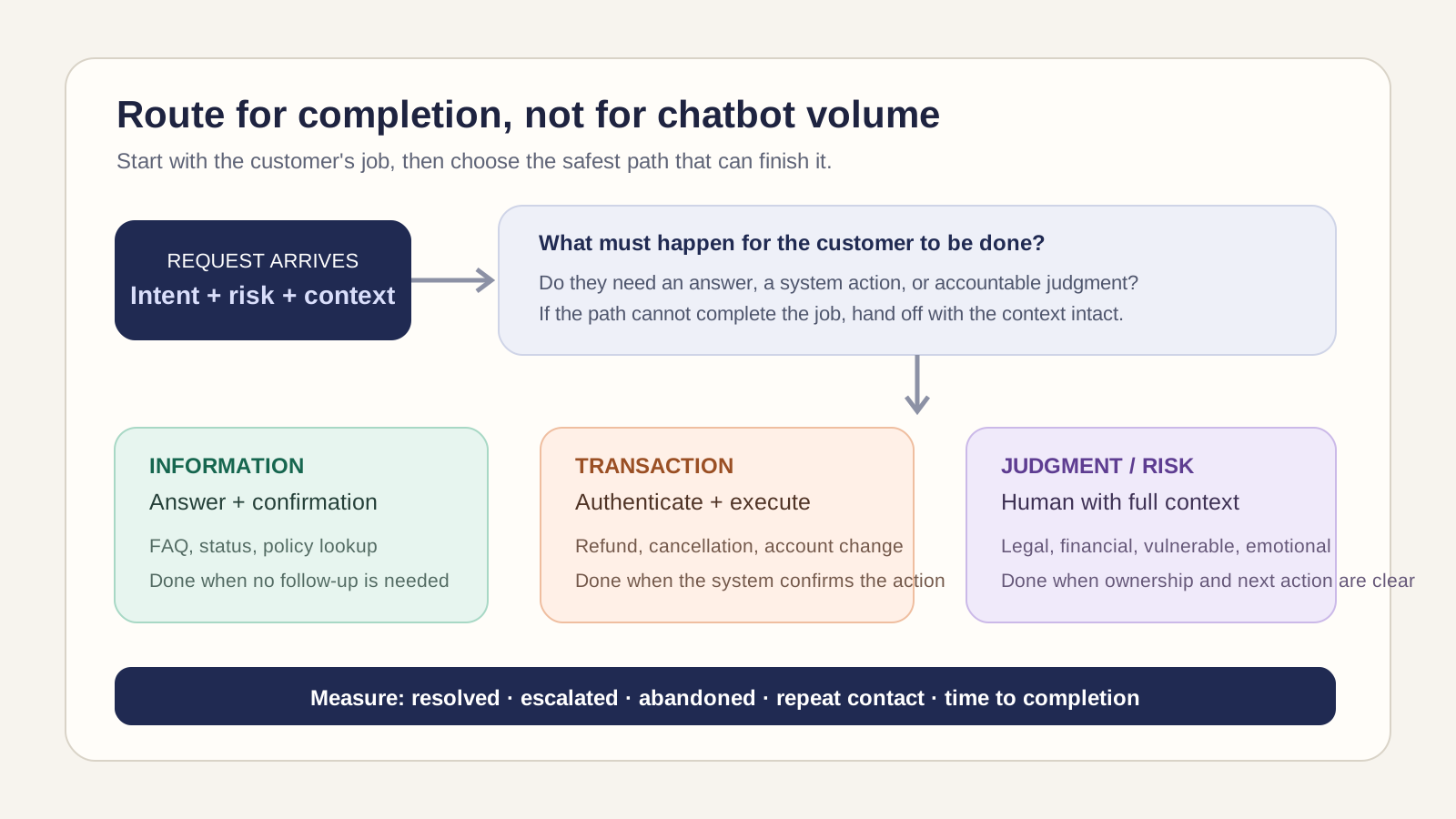
Treating every request as equally automatable creates brittle service. A simpler routing model separates information, execution, and judgment.
| Request type | Default path | Completion test | Move to a person when |
|---|---|---|---|
| Information | Chatbot | The customer confirms the answer and does not need another contact | Policy exception or conflicting information appears |
| Account or order action | Chatbot plus business system | The change is executed and a confirmation or reference number is returned | Authentication, permission, validation, or system call fails |
| High risk, judgment, or emotion | Human first | An accountable owner accepts the case and gives a clear next action | Human handling is the default, not the exception |
The first lane covers FAQs and status checks. The second depends less on fluent generation than on reliable system access, transaction controls, and recovery. The third belongs to cases involving legal exposure, meaningful financial loss, vulnerable customers, safety, or strong emotion. Holding those customers inside a bot merely to protect an automation percentage can increase frustration and lengthen the eventual call.
Some requests also carry hidden context. A phrase such as “family trip” may imply an infant, a maximum budget, no tight connections, and a refundable room. Plain document retrieval can miss the relationships among those constraints. An ontology or knowledge graph may help represent links among customers, products, and policies. It is not the first purchase to make. Begin by finding which pieces of context repeatedly disappear from transcripts and agent notes; add a relationship model only when the evidence shows a recurring need.
Routing rules should also be narrow enough to test. “Escalate frustrated customers” sounds sensible but can be noisy. Better rules identify observable signals: two failed attempts at the same action, an explicit request for a person, an authentication failure, a protected topic, or a transaction above a defined risk threshold. Broad escalation rules can flood agents, while overly strict rules trap customers. The boundary needs an owner and a review cadence.
Measure completion beyond the chatbot window
Intercom defines Fin’s automation rate as AI-resolved conversations divided by total conversations, and breaks it into involvement and resolution components. That is one vendor’s product definition, not a universal standard. The useful idea is the separation between conversations where AI appeared and conversations where AI actually resolved the issue.
For call reduction, the measurement set has to cross channels:
- AI involvement rate and AI resolution rate
- resolved, escalated, and abandoned outcomes kept separate
- same-intent repeat contact within 24 and 48 hours
- total time from the first message to a completed customer goal
- questions the agent had to ask again after handoff
- total contacts per case, not contacts per channel
- customer effort alongside satisfaction
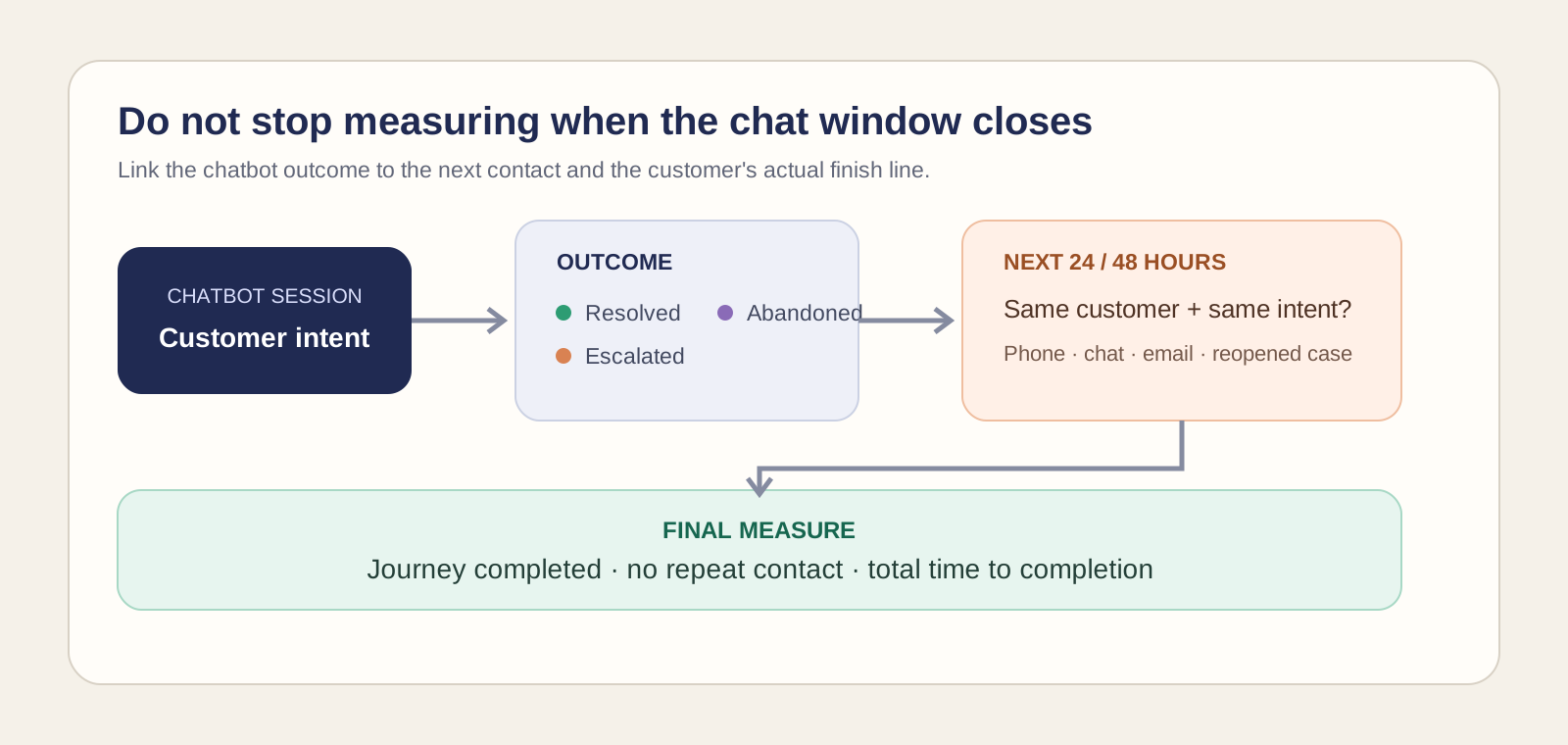
A chatbot outcome becomes meaningful only after it is linked to the next contact and the customer’s actual finish line.
If I were rebuilding the operating scorecard, “journey completed” would sit in the first column. Repeat contact, handoff quality, and time to completion would follow. Customer satisfaction remains useful as an outcome, but diagnosis needs to be split by intent, channel, customer segment, and failure reason. A single billing failure can drive a large share of calls while disappearing inside a favorable overall average.
Do not reward the chatbot for keeping a customer away from an agent when it also kept them away from a solution. Equally, do not punish a fast, context-rich escalation that prevents a long call and a second contact. The scorecard should reflect customer work completed and support work avoided, not ownership of the final message.
A two-week operating check is enough to find the first gap
There is no need to replace the whole support platform first. Start with a sample of recent calls that followed a chatbot session. For each case, record the customer’s goal, the bot’s last useful answer, why the customer called, what the agent had to ask again, and the action that finally resolved the case. If identity matching is weak, limit the sample to authenticated sessions instead of mixing estimates into the same denominator.
During the first week, classify failures into four buckets: the bot answered but could not act; it missed required context; the handoff lost information; or the case needed human judgment from the beginning. Read the associated human-agent transcripts as well. Microsoft’s transcript analysis guidance recommends using them to understand escalation drivers and identify self-service actions. Pick the most frequent actionable gap rather than opening a broad chatbot rewrite.
During the second week, connect one job end to end. For a shipping-address change, that means eligibility rules, authentication, the update API, confirmation, and a handoff that preserves state when the update fails. Test the normal path, then authentication failure, duplicate requests, system latency, invalid data, and agent unavailability. Give one owner responsibility for the completion rate and one clear rollback or manual path.
The acceptance criteria are concrete. Completion for that intent rises. Same-intent repeat calls fall. Agents no longer ask for information the chatbot already collected. If those three results do not move, friendlier wording or a more capable language model will not make the call queue disappear.
An AI chatbot is not a wall that stops phone calls. It is an entrance that should finish simple work and carry intact context to a person when the work becomes complex. The difference is made by transaction authority, cross-channel measurement, handoff quality, and an honest definition of resolution—not by the number of answers the model produced.
References and reporting
Public pages used for reported facts, official documentation, policy background, product details, and claims that may change.
- Use the Copilot Studio bot dashboardMicrosoft LearnUsed for: resolved, escalated, and abandoned outcomes; deflection definitionChecked: 2026-08-13
- Configure handoff to customer engagement hubsMicrosoft LearnUsed for: conversation history and context variables in handoffChecked: 2026-08-13
- Analyze human-agent transcriptsMicrosoft LearnUsed for: finding escalation driversChecked: 2026-08-13
- Virtual agent to human agent transfersGoogle CloudUsed for: transfer reasons and conversation historyChecked: 2026-08-13
- Fin AI Agent automation rateIntercomUsed for: example automation, involvement, and resolution definitionsChecked: 2026-08-13
- Customer service chatbots: Anthropomorphism and adoptionJournal of Business ResearchUsed for: unresolved errors and chatbot adoptionChecked: 2026-08-13
- Can chatbot customer service match human service agents on customer satisfaction?Journal of Retailing and Consumer ServicesUsed for: light human intervention and customer satisfactionChecked: 2026-08-13