
The cursor blinks on an empty screen. A junior developer writes a requirement, deletes it, adds an exception, and points the coding agent toward the part of the repository that must not break. A few minutes later, several files have changed. The developer runs the result and asks a second model to review the diff.
That is no longer an unusual experiment. For many juniors, more time now goes into deciding what to ask for, reading generated code, and tracking down the part that is almost right. The speed is real. So is the unease: if the tool can produce in minutes what used to take a day, what exactly is a junior developer supposed to get good at?
“Learn the fundamentals” is still sound advice, but it is too vague on its own. “Just learn the tools” is worse. The useful answer sits between those two positions: keep the fundamentals, but change the order in which you learn them and the evidence you use to prove that you understand them.
Writing less code does not mean making fewer decisions
The traditional junior path relied on repetition. Build a small endpoint, fix a bug, write a migration, learn the framework by touching it every day. AI can now draft much of that work before the developer has formed a complete mental model.
That creates an awkward gap. Running code is not the same as understood code. A feature can pass the happy path while duplicating a payment, leaking a token into a log, or failing when the same request arrives twice.
The 2025 Stack Overflow Developer Survey captured that tension. More respondents distrusted the accuracy of AI output than trusted it. The most common frustration was an answer that was “almost right, but not quite,” and 45% said debugging AI-generated code could take more time. This is not evidence that AI is useless. It is evidence that generation speed and engineering responsibility live in different places.
For a junior developer, the danger is not using AI. The danger is merging work that cannot be explained once the agent has moved on.
Fundamentals now have a more immediate job
Data structures, networking, databases, and operating systems have not lost their value. What has changed is why a junior reaches for them.
Suppose an agent adds a cache. A useful review begins with three questions:
- Does the system remain correct when the cache is empty?
- What event invalidates an entry?
- Can the service fall back to the source of truth during an outage?
Those are not prompt tricks. They come from understanding state and failure. The same applies elsewhere: a junior does not need every HTTP header committed to memory, but should be able to trace where credentials travel. They may not hand-write every SQL query, but should recognize when a query plan will collapse under real data.
Fundamentals are becoming less like an entrance exam and more like a set of instruments for detecting plausible mistakes.
Ownership starts before seniority
Most respondents in the Stack Overflow survey did not plan to use AI for deployment and monitoring, and a similar majority did not plan to hand over project planning. Once a change reaches those stages, the question is no longer just “does it work?” It becomes “who will stop it, explain it, and recover it when it does not?”
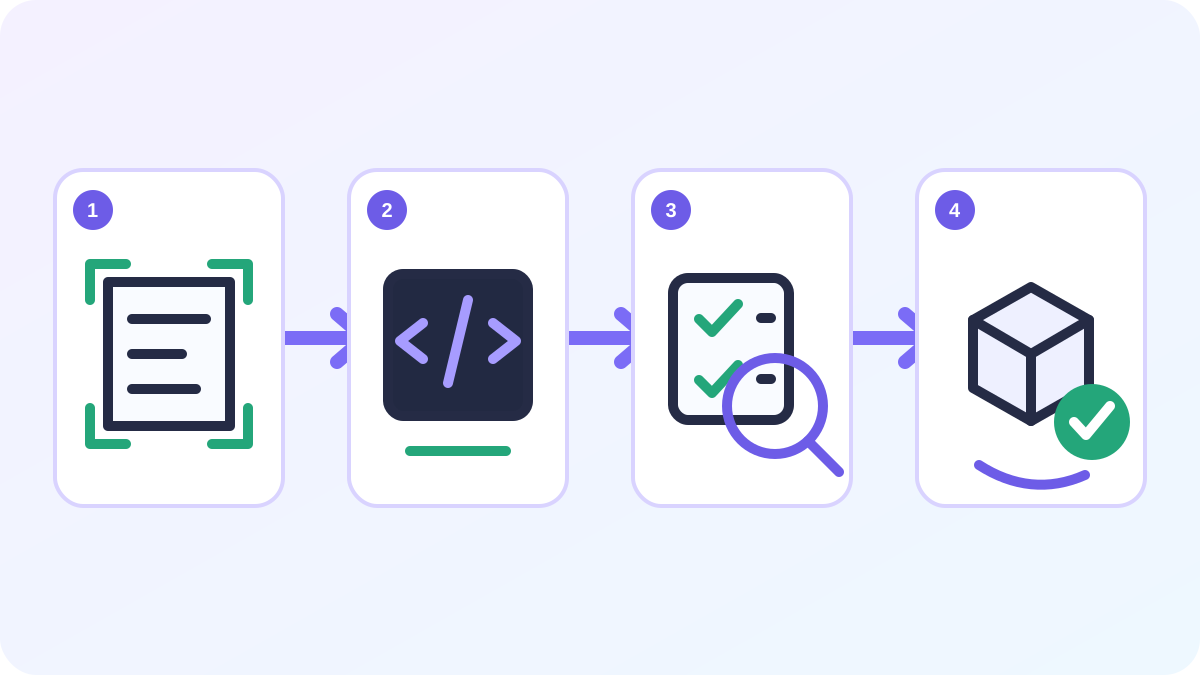
A junior does not need to design a company-wide architecture. They should, however, be able to describe the boundary of the small feature they own: where its input comes from, what state it changes, what remains after failure, and who can safely retry it.
That also changes what a good portfolio looks like. Ten polished screens reveal less than a modest feature accompanied by the evidence below.
| Evidence worth keeping | What it demonstrates |
|---|---|
| The first requirement and why it changed | Problem framing |
| AI suggestions that were rejected | Technical judgment |
| One reproducible failure | Debugging discipline |
| Tests and operating logs | Verification habits |
| A rollback or recovery note | Ownership under failure |
This is not an apology for using AI. It is proof that a person remained in charge of the decision.
Feeling faster is not the same as finishing sooner
AI coding tools feel fast because the first visible output arrives quickly. That is not always the same as reducing total work.
METR studied experienced open-source contributors working in repositories they already knew, using early-2025 AI tools. The participants expected a speedup; measured completion time was 19% longer. The result should not be generalized to every developer or current model. It involved experienced contributors, specific repositories, and tools that have already changed.
The useful lesson is narrower: count review, repair, and rollback time, not just generation time. A junior should measure how many changes they can explain and finish safely, rather than how many lines an agent produced.
A twelve-week practice plan that produces evidence
One small service is enough. Give it authentication, persistent data, one external API, and a basic admin view. The goal is not a startup launch. The goal is to carry a bounded system from idea to operation.
Use a plain definition of done each week: the feature works, one failure can be reproduced, the important decision is written down, and another developer can run it without reopening the AI chat. That is stronger evidence than a large commit whose reasoning exists only in conversation history.
Weeks 1–3: Build with AI, but read every change. Write one sentence explaining the purpose of each modified file. Do not merge a change you cannot describe.
Weeks 4–6: Introduce failure on purpose. Add latency, malformed input, duplicate requests, and expired credentials. Narrow the cause through logs before asking the agent for a fix.
Weeks 7–9: Add operating evidence. Instrument important requests, keep a regression test for each failure, and write down how to return to the last working version.
Weeks 10–12: Hand the service to someone else. A reader should be able to run it from the README, understand the main tradeoff, and see which limitation remains. If no colleague is available, leave it for a day and test whether your future self can do it.
Keep four lines at the end of each week:
- The problem you intended to solve
- What the agent proposed and what you rejected
- One failure you actually observed
- What you will inspect first next time
That record survives the next model release.
Spend some time with the agent switched off
This is not a call to rebuild everything by hand. It is a way to locate the edge of your understanding. Draw the data path before opening the chat. Write the test cases before asking for code. Explain the failure aloud before requesting a diagnosis.
When the agent is on, use it without embarrassment. Let it remove repetition, find an unfamiliar library’s entry point, and widen the list of tests. The relevant distinction is not AI versus no AI. It is delegated work versus verified work.
The place left for junior developers
Someone still has to define the problem, notice the user’s pain, stop a bad release, and explain why a choice was made. None of those responsibilities belongs exclusively to senior engineers.
Junior developers do not need to race an agent at typing. They need practice noticing when an answer smells wrong, checking the evidence, and carrying one small feature into a state that another person can operate. A backend developer can add AI to the systems they already understand. A frontend developer can design interfaces that make uncertainty visible instead of hiding it.
Tool names and job titles will keep changing. The ability to frame a problem, understand its context, and accept responsibility for the result is much harder to automate away. That is where a junior should invest now.
References and reporting
Public pages used for reported facts, official documentation, policy background, product details, and claims that may change.
- 2025 Developer Survey: AIStack OverflowUsed for: trust in AI output; debugging burden; human responsibility for planning and deploymentChecked: 2026-08-25
- 2025 Developer Survey methodologyStack OverflowUsed for: survey timing and methodChecked: 2026-08-25
- Measuring the Impact of Early-2025 AI on Experienced Open-Source Developer ProductivityMETRUsed for: experienced developer productivity experiment; perceived versus measured speedChecked: 2026-08-25