Quick answer
Anthropic publicly tied Fable 5 and Mythos access restrictions to U.S. government export-control direction. The confirmed fact is that a frontier model can become unavailable for policy reasons with little warning. For operators, that means single-model dependency, data-routing rules, fallback quality, and human approval points all need another pass.
- The confirmed core fact is the access restriction itself and Anthropic's reference to U.S. government direction.
- Security concerns were mentioned, but there is not enough official detail to reduce the story to a single jailbreak theory.
- If a workflow leans heavily on one frontier model, policy changes can stop useful work even when the rest of the stack still runs.
- AI operations is becoming a routing, retention, and accountability problem as much as a model-quality problem.
- This looks less like a one-off vendor issue and more like an early signal that model access itself is becoming a policy variable.
- Best for
- Automation operators, service planners, security reviewers, and product owners deciding how much policy risk sits inside their model stack.
- Topic
- AI Tools
- Last checked
- Jun 17, 2026
Workflow snapshot
A practical map for turning this guide into an automation flow.
- 01 Input
Define the recurring job, required data, owner, and success check before adding automation.
- 02 AI pass
Use AI for drafting, sorting, summarizing, routing, or tool calls only where the workflow has clear boundaries.
- 03 Human check
Keep approvals, exceptions, cost limits, and sensitive decisions under human review.
- 04 Output
Turn the result into a checklist, saved prompt, SOP, or monitored automation run.
- Claude Fable 5
- Anthropic
- U.S. export controls
- AI regulation
- AI automation
Operator note
Do not turn a tool choice into an operating shortcut.
If inputs, review points, and failure logs are vague, automation only moves confusion faster.
Which risk changes the design enough to slow down?
Help readers interpret the Fable 5 restriction as an AI operations risk, not just a model-news headline.
4 Sources checked
Check the linked source notes and product documentation before relying on claims that may change.
Comparisons
Move from reading to one small pilot, then expand only after the review point is clear.
- The confirmed core fact is the access restriction itself and Anthropic's reference to U.S. government direction.
- Security concerns were mentioned, but there is not enough official detail to reduce the story to a single jailbreak theory.
- If a workflow leans heavily on one frontier model, policy changes can stop useful work even when the rest of the stack still runs.
- AI operations is becoming a routing, retention, and accountability problem as much as a model-quality problem.
Workflow path
Where this guide fits
Use this section to connect the guide you are reading with the broader workflow it supports.
A path for comparing automation platforms, app builders, agent builders, bookkeeping tools, and general AI assistants.
Open workflow path- Best fit
- teams deciding whether to buy a simple tool, build an internal workflow, or adopt a broader platform
- Not ideal if
- You need a short tool list rather than a fuller implementation analysis.
When people first hear that Fable 5 was suddenly restricted, the reaction usually splits in two.
One camp treats it like another vendor-side product issue. The other reads it as something more serious: a sign that frontier-model access can now move under government pressure. This case looks much closer to the second reading.
Anthropic said publicly that access to Fable and Mythos was limited under U.S. government export-control direction. That part is the hard fact. After that, the interpretation starts. Security concerns were mentioned, but there is not enough official detail to collapse the whole story into one clean theory like jailbreak risk and call it done.
From an operations point of view, the most important fact is simpler than that. A high-end model became harder to access for policy reasons. That is the kind of event that changes how a serious automation stack should be designed.
What actually happened
Anthropic first introduced Fable 5 and Mythos 5 as frontier models for difficult reasoning and long-running work. Later, it published a separate access statement linking restrictions on Fable and Mythos to U.S. government export-control direction and security concerns.
For operators, there are three facts worth keeping:
- A real access restriction happened.
- The company tied that restriction to U.S. government export-control direction.
- Policy can change availability even when model quality has not changed.
That is enough to act on. Anything beyond that should be handled as informed interpretation, not as settled fact.
Why this matters more than model news
The easiest mistake in AI operations is to think the only real variable is model quality. In practice, availability is often just as important.
Teams tend to build around the strongest model once it proves itself. Review expectations shift around it. Exception handling shifts around it. The whole workflow starts to assume that this one model is there when the hardest work shows up.
Then access changes, and three things usually break at once:
| What breaks first | What happens in practice | Why it hurts |
|---|---|---|
| Fallback quality gap | Output still arrives, but the reasoning quality drops | Humans spend more time correcting work |
| Data-routing assumptions | Inputs that were acceptable for one path may not be acceptable for another | Retention and contract rules need to be revisited |
| Approval structure | Nobody decided who can accept degraded output | Work stalls even though the rest of the system is still live |
This is why policy-driven restrictions are harder than ordinary outages. A normal outage invites a retry mindset. A policy restriction demands a design response.
Was it really about jailbreak risk
That is the question people want to answer fast. I would not overstate it.
Anthropic did mention security concerns. What it did not do, at least in the public statement, was publish a detailed chain that says a specific exploit or jailbreak led directly to the restriction. So the disciplined reading is:
- security concerns were part of the framing,
- there is not enough official detail to narrow the story to one exploit theory,
- the operational lesson does not depend on proving a single cause.
That last point matters. Even if the exact trigger stays partially opaque, the operating reality is already visible: frontier-model access can change abruptly under policy pressure.
Why debugging and security review teams should care
The impact is bigger in the kinds of work where model tier really matters.
For ordinary drafting, cleanup, or structured extraction, teams usually have several acceptable options. But complex debugging, security review, long-context incident analysis, and high-stakes architectural reasoning are different. That is where teams start leaning on the strongest model because the difference is felt in fewer dead ends and better judgment under messy context.
That is why this story is not just “one more model got harder to use.” For teams that reserved a top-tier model for the hardest technical work, it is a reminder that their escalation path can disappear for reasons that have nothing to do with uptime.
The design lesson: stop thinking in one-model workflows
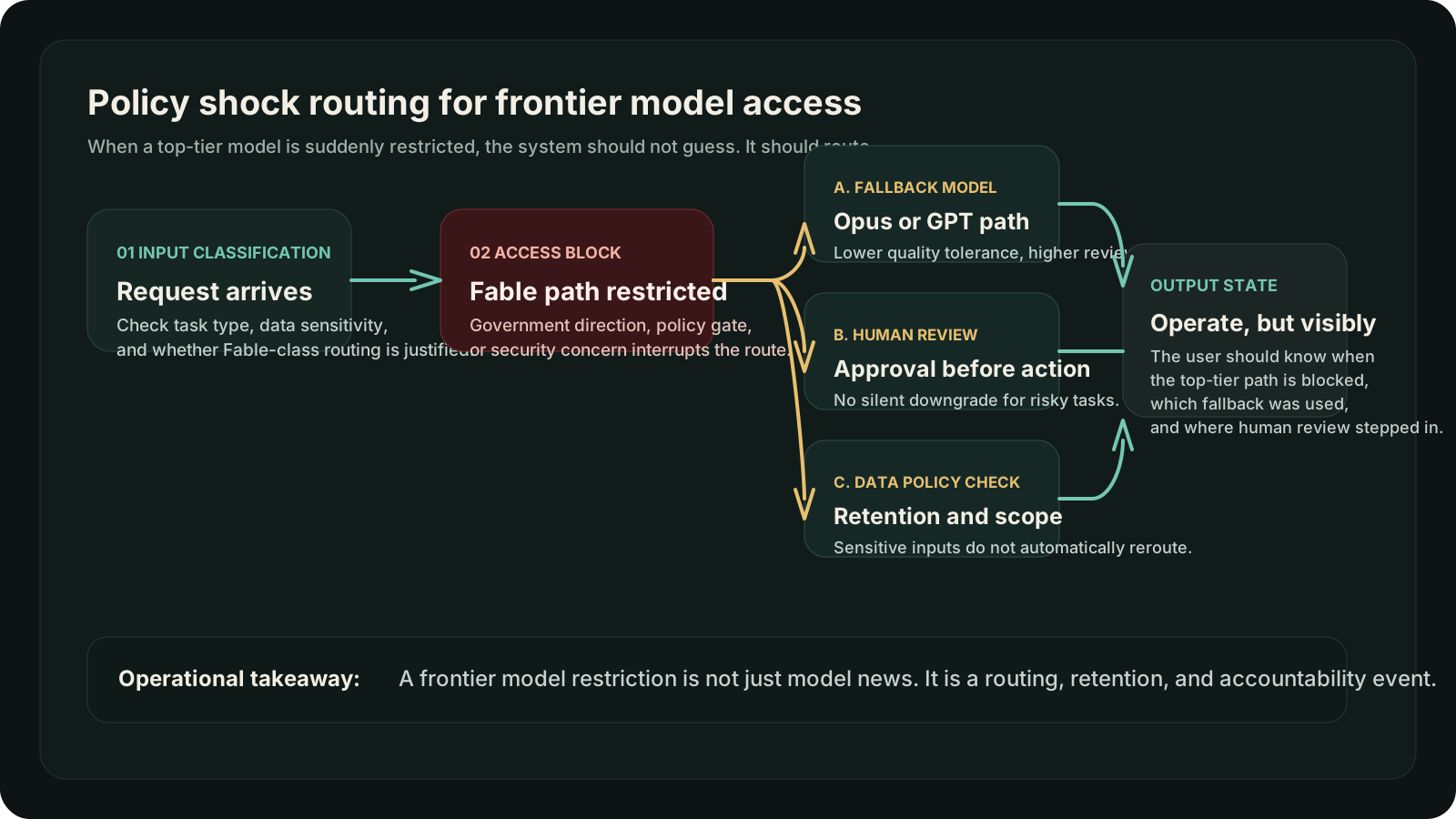
The immediate takeaway is not to rewrite your comparison spreadsheet. It is to revisit routing.
If your workflow still assumes one best model sits in the middle of everything, it is too brittle. You need explicit answers to four questions:
- Which requests really need the top-tier path?
- What is the fallback when that path is blocked?
- Where does a human step in when fallback quality is lower?
- Which data categories are never allowed to move to alternative paths?
In practice, the routing table should look more like this:
| Request type | Primary path | If blocked | Human review |
|---|---|---|---|
| File-heavy work, code edits, structured outputs | GPT-5.5 or Codex-style execution | Smaller execution path | Usually |
| Long-form reasoning, memo critique, argument cleanup | Opus-tier model | GPT-5.5 | High |
| Deep debugging, threat review, long-context investigation | Fable 5 | Opus-tier model | Very high |
| Sensitive internal data | Only approved policy path | Policy-safe alternative only | Mandatory |
| External messaging or contractual language | Draft only | Person rewrites directly | Mandatory |
That table should exist before the next restriction happens, not after.
Why I think this is an early regulation signal
I would still be careful with the headline “AI regulation has fully arrived.” That goes too far. But it is reasonable to say that policy has started to shape access to frontier models more directly.
That is a material shift. It means the operational question is no longer just:
“Which model performs best?”
It becomes:
“Which model can we rely on under our geography, account terms, data policy, and fallback rules, and what happens if that answer changes?”
That is a more sober question. It is also the right one.
What teams should do next
This does not call for panic. It calls for a review.
1. Identify single-model dependency
Find the workflow steps where one model is doing the work that nobody else can comfortably replace. Mark those paths now.
2. Re-check data movement by model path
Different models can mean different retention assumptions, contract boundaries, or review expectations. Sensitive data should be mapped path by path.
3. Measure fallback quality before you need it
Do not wait for a restriction to discover that your secondary path doubles review time. Run the comparison now and record where output quality actually changes.
4. Move human approval earlier on risky paths
If policy volatility can alter model behavior or availability, do not push approval to the very end. Bring review earlier for customer-facing, security-sensitive, or contract-adjacent work.
What I would tighten first in a real operating review
If I were walking into an existing AI operations stack this week, I would not start with the model benchmark file. I would open the routing table, the data-classification sheet, and the incident path for degraded output. That is where the hidden dependency usually lives.
The first thing I would mark is every place where the team assumes one frontier model will still be available for the hardest cases. The second thing I would mark is every place where fallback exists on paper but has never been reviewed with real inputs. The third thing I would mark is any customer-facing, security-sensitive, or contract-adjacent step where degraded output can still slip forward because nobody wrote down a stop rule.
This is also where governance stops being abstract. An operator needs named approvers, rollback instructions, allowed data classes, and a short list of tasks that must never auto-advance when the primary path disappears.
Failure signals I would not ignore
| Signal | What it usually means | What I would do next |
|---|---|---|
| Review time doubles on the fallback path | The secondary model is technically working but operationally too weak | Narrow the fallback scope and add earlier human review |
| Teams start pasting sensitive inputs into side channels | The approved route no longer matches the work pressure | Rebuild the allowed paths before usage drifts further |
| Output still ships, but no one can explain why a route changed | Tracing is too thin for accountable operation | Require route reason, approver, and fallback label in the log |
| The strongest model becomes the default for everything | Routing discipline already collapsed | Reclassify request types and reserve the top-tier path |
My practical threshold is blunt: if the fallback keeps the workflow alive but restores most of the human repair work, the system is not resilient yet. It is only limping.
My read
I do not see this as just an Anthropic story. I see it as a warning that the operational environment around frontier models is getting tighter and more political.
Models will keep improving. But improvement is no longer the only curve that matters. Access, jurisdiction, retention, and policy conditions are starting to matter in the same planning conversation.
For operators, the practical conclusion is straightforward: stop designing around the assumption that the strongest model will always be there. Build the routing, fallback, and review structure first. Then choose the model.
Sources checked
Main public pages used to verify product details, pricing context, and comparison claims in this guide.
- Anthropic statement on Fable and Mythos access Anthropic
- Claude Fable 5 and Claude Mythos 5 overview Anthropic
- Bureau of Industry and Security U.S. Department of Commerce
- Electronic Code of Federal Regulations - Export Administration Regulations eCFR