Quick answer
The Fable 5 restriction should not be read as a narrow vendor incident. It shows that model access itself can become an operating variable. Enterprise AI automation now needs clearer request classification, fallback routes, approval checkpoints, data boundaries, and replayable logs.
- The danger is not one blocked model. The danger is building too much around one model.
- This incident moves model access from a procurement issue into an operating issue.
- Enterprise automation needs multi-path design more than single-model excellence.
- Sensitive workflows need prewritten review rules, routing logic, and logging standards.
- Teams that moved fast without structure may feel more pain than teams that moved slower with discipline.
- Best for
- Service planners, automation owners, product teams, and security reviewers redesigning enterprise AI workflows.
- Topic
- Automation
- Last checked
- Jun 17, 2026
Workflow snapshot
A practical map for turning this guide into an automation flow.
- 01 Input
Define the recurring job, required data, owner, and success check before adding automation.
- 02 AI pass
Use AI for drafting, sorting, summarizing, routing, or tool calls only where the workflow has clear boundaries.
- 03 Human check
Keep approvals, exceptions, cost limits, and sensitive decisions under human review.
- 04 Output
Turn the result into a checklist, saved prompt, SOP, or monitored automation run.
- Fable 5
- AI automation
- model governance
- enterprise automation
- fallback design
Operator note
Do not turn a tool choice into an operating shortcut.
If inputs, review points, and failure logs are vague, automation only moves confusion faster.
Which operating rule should guide the decision?
Helps enterprise automation owners treat model-access shocks as workflow design problems rather than vendor gossip.
5 Sources checked
Check the linked source notes and product documentation before relying on claims that may change.
Comparisons
Move from reading to one small pilot, then expand only after the review point is clear.
- The danger is not one blocked model. The danger is building too much around one model.
- This incident moves model access from a procurement issue into an operating issue.
- Enterprise automation needs multi-path design more than single-model excellence.
- Sensitive workflows need prewritten review rules, routing logic, and logging standards.
Workflow path
Where this guide fits
Use this section to connect the guide you are reading with the broader workflow it supports.
A path for comparing automation platforms, app builders, agent builders, bookkeeping tools, and general AI assistants.
Open workflow path- Best fit
- teams deciding whether to buy a simple tool, build an internal workflow, or adopt a broader platform
- Not ideal if
- You need step-by-step setup instructions more than a decision framework.
At first glance, the Fable 5 restriction looks like a vendor story. One company had a problem, one model got limited, and the rest of the market moves on. I do not think that is the right reading.
What matters is not only that a high-end model became harder to access. What matters is that access itself moved into the operating layer. For teams building AI automation, that changes the planning question. It is no longer enough to ask which model performs best. The more serious question is what happens to the workflow when that model is suddenly unavailable, region-limited, policy-gated, or held behind a security review.
That is why I would treat this as a design warning, not just a news item.
The part teams underestimate
In real organizations, a strong model tends to attract more work over time. It starts with one use case, then picks up draft writing, research synthesis, log review, support triage, contract reading, and eventually harder judgment tasks. At some point, the team quietly builds a dependency around it.
Nobody usually says it out loud. But the assumption is there: this model will remain available enough to anchor the workflow.
The Fable 5 story exposes how fragile that assumption can be.
Anthropic publicly linked the restriction on Fable and Mythos access to a US government export-control directive. That does not mean every enterprise model will face the same outcome next week. It does mean that model access now belongs in the same conversation as vendor risk, approval design, data routing, and operational fallback.
This is not mainly about model quality
A lot of teams will respond by reopening model scorecards. That is not the first move I would make.
The first move is to look at workflow structure.
If your automation depends on one frontier model for the hardest parts of the job, a policy or supply shock will not always create a clean outage. More often it creates a slower, more expensive failure mode. The workflow still runs, but the quality drops, review time expands, and people start doing the difficult parts manually again.
That is a worse problem than a visible outage, because it hides inside normal operations.
Take a debugging or incident-review workflow. A top-tier model may be the one your team trusts for linking logs, exceptions, code paths, and config drift into one coherent hypothesis. If that model disappears from the path, a fallback may still summarize the material but miss the deeper thread. On paper, the automation is “still working.” In practice, a senior operator is back in the loop for every serious case.
That is the kind of operational drag people do not budget for.
The redesign starts with request classification
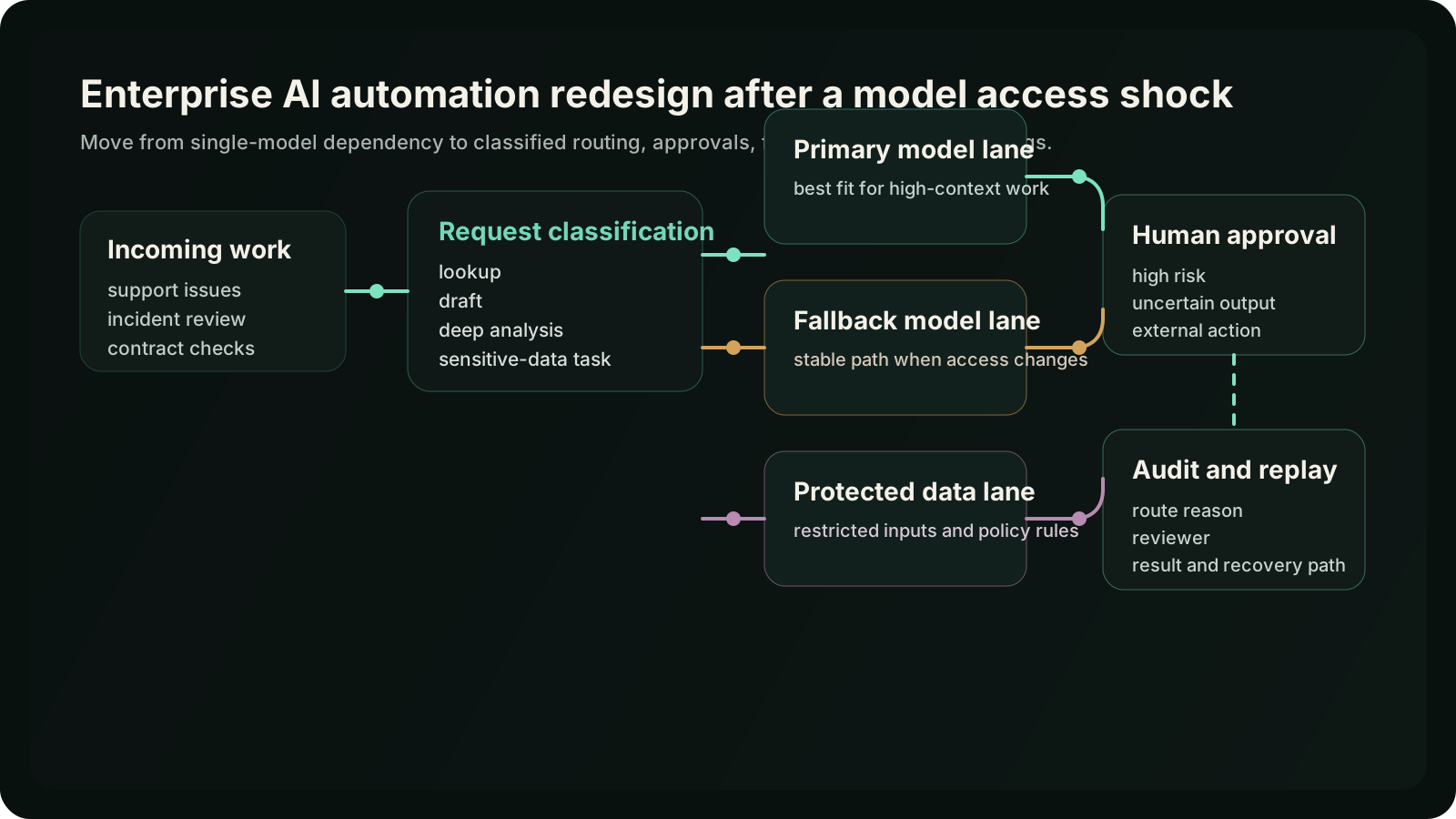
The easiest way to get into trouble is to send everything through the same path. That includes simple lookups, rough drafts, high-context analysis, sensitive customer data, and actions that can change systems.
Those do not belong in one bucket.
If I were reviewing an enterprise automation stack after this incident, I would want to see at least five classes of work:
- basic lookup
- draft generation
- deep analysis
- sensitive-data handling
- execution or state-changing actions
That breakdown sounds mundane, but it changes the entire design.
| Weak pattern | Stronger pattern |
|---|---|
| One preferred model handles most complex work | Different request classes have different model paths |
| Fallback is decided ad hoc during trouble | Fallback rules exist before the incident |
| Sensitive inputs move through the convenient path | Sensitive inputs are routed by policy, not convenience |
| Human review happens “where needed” | Human review is tied to explicit thresholds |
| Logs show calls but not decision context | Logs preserve route, reason, reviewer, and result |
Where real pain usually appears first
This sort of redesign does not begin in strategy decks. It usually begins in the first painful week after a dependency breaks.
Work that only feels safe on one top-tier model
This tends to show up in long-context investigation, security review, dense contract reading, complex debugging, or any task where the model has to keep many moving parts together without losing the thread. Teams may discover that their fallback is fine for summaries but weak for judgment-heavy work.
That is not a sign to panic. It is a sign to narrow which tasks truly need that class of model.
Workflows with vague data boundaries
Teams often reuse the same prompt path because it is convenient. Then a policy shift lands and suddenly everyone needs to ask whether the same inputs can still move through the same route. Customer identifiers, internal incident logs, contract terms, and security findings are the obvious danger zones.
This is why data boundaries should be defined before they are tested by a restriction.
Approval rules that only exist in people’s heads
Many automations fail here. The model output looks plausible, but the actual approval logic lives inside one manager, one operations lead, or one senior analyst. When that happens, the workflow never becomes trustworthy. Reviewers simply redo the work.
That is not automation. It is draft inflation.
Logs without explanation
A system may record which tool was called and when. That is not the same thing as explaining why a request took that route, why it escalated, or why a reviewer accepted the result. The missing layer is decision context, and that is what makes post-incident review possible.
What should be redesigned now
I would start with four things.
1. Rewrite the routing table
Decide which requests deserve a frontier model, which requests can use a cheaper or more stable path, which inputs should never leave a guarded lane, and which outcomes always need human review.
2. Test the fallback in practice
Saying “we can use another model if needed” is not enough. Teams need to run actual inputs through the alternate route and compare not just answer quality, but structure, missing fields, reviewer effort, and time-to-decision.
3. Move human review to the right place
The goal is not to eliminate review. The goal is to stop reviewing the wrong things. High-risk outputs, sensitive actions, and uncertain cases deserve review. Low-risk retrieval and early draft work usually do not need the same scrutiny.
4. Treat model-access shocks like operational incidents
Teams prepare for API errors and infrastructure failures. Many do not prepare for policy limits, regional restrictions, or model removals. They should. This class of disruption now belongs in operational planning.
The teams that last will not be the fastest teams
Early momentum can be misleading in AI automation. Teams that move quickly often look ahead because they demonstrate visible output sooner. But the teams that last tend to be the ones with tighter structure: explicit review thresholds, route separation, replayable logs, and real fallback drills.
The uncomfortable point is this: the teams that tied themselves most deeply to one excellent model may feel the most pain when access changes.
My conclusion after the Fable 5 shock
I would not read this incident as a reason to stop using advanced models. That would be too simple and not especially useful.
I would read it as a reminder that enterprise AI automation has moved past the stage where model choice alone can carry the design. Access, policy, routing, approvals, logs, and recovery paths now deserve equal weight.
Put more bluntly: the next competitive edge will not come only from choosing the smartest model. It will come from building a workflow that still holds together when the smartest model is suddenly not there.
My operating call after this model news
This is the part I would write into the operating memo, not leave in someone’s head.
| Condition | Why I would stop expansion there | What has to be true before reopening |
|---|---|---|
| Fallback output adds back most of the reviewer workload | The automation is only moving effort, not removing it | Review burden drops in repeated runs and the route is documented |
| Sensitive inputs are being copied to unofficial paths | Convenience has already outrun policy control | Approved paths, approvers, and blocked data classes are explicit |
| Teams cannot explain who accepted degraded output | Accountability is already too weak | Named owners, approval steps, and rollback rules exist |
| A single premium model has become the default for every hard task | One policy change can now shake the entire workflow | Requests are classified and premium routing is reserved |
I do not need a dramatic incident to call this out. If I see these four signals in a weekly review, I treat the design as brittle already.
The decision note I would leave for leadership
The wrong response is “find a new best model.” The better response is “remove hidden assumptions from the flow.” That means request classification, policy-safe routing, tested fallback, earlier approval on risky paths, and logs that explain not only what the system did but why it did it.
In plain terms: if the strongest model disappeared tomorrow, could your team still finish the week without rebuilding the workflow by hand? If the honest answer is no, the redesign is not optional.
Sources checked
Main public pages used to verify product details, pricing context, and comparison claims in this guide.