
GPT-5.6 is here. OpenAI presents it as one of its strongest model families so far. But the best version is not something most people can simply open and use.
On June 26, 2026, OpenAI announced GPT-5.6 Sol, Terra, and Luna as a limited preview. Sol is the top model, Terra is the balanced one, and Luna is the faster, cheaper path. That sounds like a product launch, but it is not a normal public release. OpenAI says the preview is not available in ChatGPT, and API and Codex access are limited to trusted partners during the preview period.
That is the strange part. The model may be exceptional. The access is not ordinary.
Two weeks earlier, Anthropic had already shown a similar problem in a rougher way. Fable 5 and Mythos 5 were restricted after a U.S. national-security export-control directive. On June 30, Anthropic said those controls had been lifted and Fable 5 would return globally on July 1, with Mythos 5 only partly restored. So the story is not that Fable 5 vanished. The more important point is that a frontier model could have access paused or restricted, then later restored after government and company follow-up.
That is the shift I think matters.
Why I wrote this
I came back to this story because the benchmark table is no longer the main event. The more practical question is whether the model you plan around will be available when the work actually needs it.
The access question I used as the test
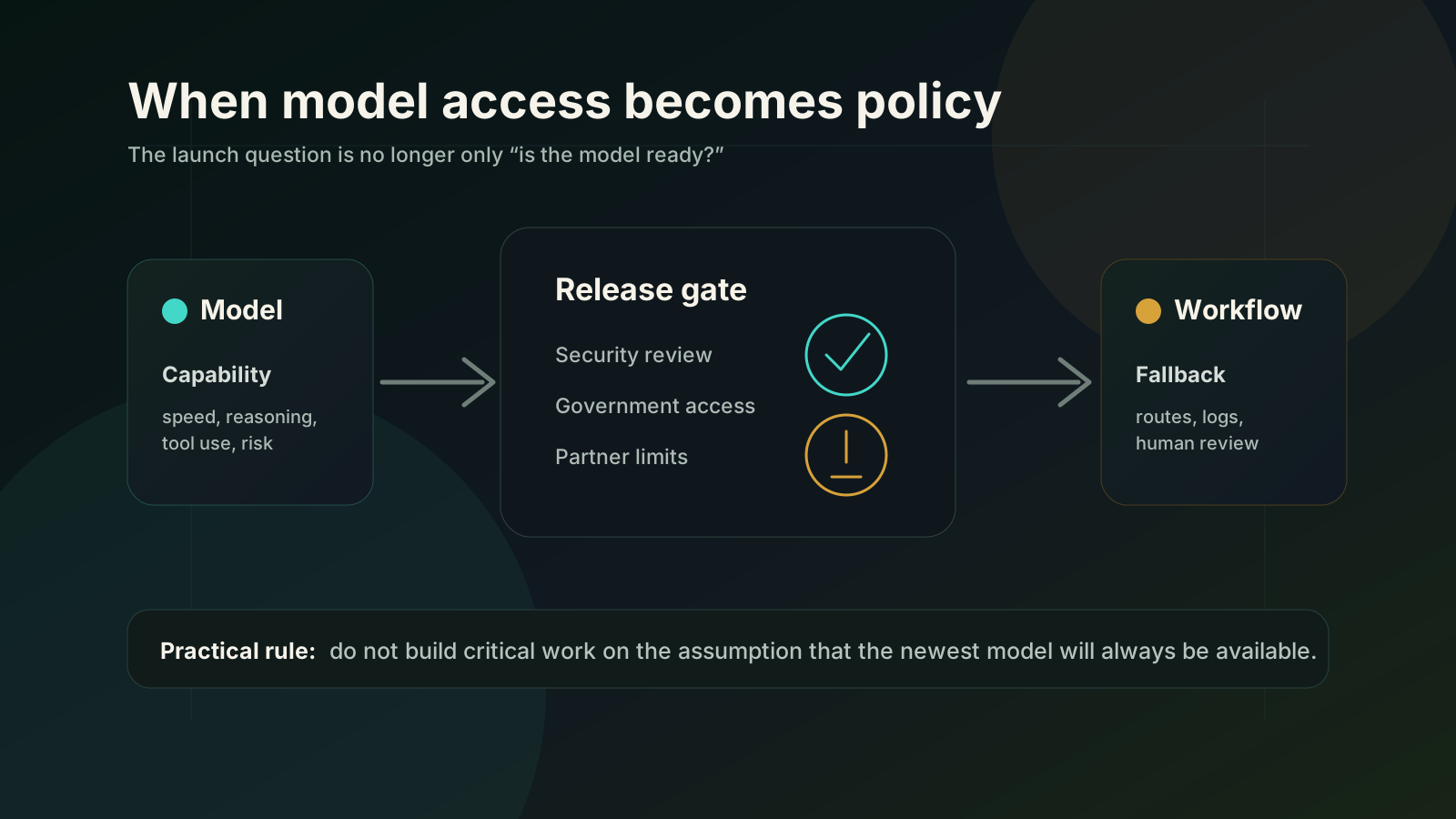
The performance story is strong, but I did not treat the benchmark table as the decision. I used one practical question instead: if a team planned a serious review or build process around GPT-5.6 Sol, what would break if access stayed limited for another month? That question changes the reading. The model is positioned for software engineering, computer use, professional knowledge work, scientific research, and cybersecurity, but those are exactly the places where access, audit, and fallback matter.
But the strongest version is not broadly available. ChatGPT users do not simply get it. API and Codex users need to be in the limited partner lane. OpenAI says it plans broader availability, but not on a date I would build a roadmap around.
This changes how model launches should be read. I would not ask only how good the model is. I would ask who gets it first, who waits, what work is paused during the wait, and whether the team has a second route before the first one disappears.
What the U.S. government request means
Axios reported that the U.S. government asked OpenAI to coordinate or limit the GPT-5.6 release. I would not turn that into a simple claim that every frontier model now needs formal government approval. Executive Order 14409 reads more like a voluntary coordination framework than a mandatory licensing system.
Still, a line moved. A company built a top model, but the release path was shaped by government security concerns. That is not the same as a formal approval requirement, but operationally it can look similar: selected partners get early access while everyone else waits.
What I compared in practice
Anthropic’s case was different. Fable 5 and Mythos 5 had already been announced, then access was suspended or restricted after a U.S. export-control action. Anthropic later said the controls were lifted and Fable 5 would restart globally on July 1.
That sequence matters. It tells users that frontier model access is not just a vendor feature. It can be interrupted by policy and later restored after follow-up. If a company has built customer work, security review, research, or code review around one model, this is not a small operational detail.
Timeline
| Date | Event |
|---|---|
| June 2 | The U.S. administration signs Executive Order 14409 on advanced AI innovation and security |
| June 9 | Anthropic announces Fable 5 and Mythos 5 |
| Around June 12 | Access to Fable 5 and Mythos 5 is suspended or restricted after U.S. export-control action |
| June 24 | Reporting says the U.S. government asked OpenAI to coordinate the GPT-5.6 release |
| June 26 | OpenAI announces GPT-5.6 Sol, Terra, and Luna as a limited preview |
| June 30 | Anthropic says Fable 5 will return globally on July 1 and Mythos 5 will be partly restored |
Official statements and reporting do not carry the same weight. I treat them separately. The broad direction is still clear: in June 2026, frontier AI access became public policy news.
Access now matters as much as capability
The best AI model may exist, and you may still be unable to use it. That is different from ordinary software. With most software, paying for the right plan usually opens the feature. For the most capable previews, access may depend on partner status, region, account type, security review, and government coordination. Payment is only one part of the gate.
For individual users, this means a model announcement does not guarantee a better workday. For companies, it means procurement and access planning matter as much as benchmark charts.
Security is only part of the access story
The security argument is not fake. Strong models can help with vulnerability analysis, code generation, automated exploration, persuasive text, and rapid operational planning. Governments have a reason to care.
But security does not explain everything. Frontier models now sit inside technology competition, export controls, government procurement, IPO pressure, and enterprise contracts. Model access is becoming a strategic signal, not just a safety question.
The same question will reach Gemini, Grok, and open models
Gemini, Grok, Llama-class models, and other frontier systems are likely to face similar questions. Which models count as covered frontier models? Which evaluations matter? Which countries or partners get access first? Which capabilities are safe for broad consumer release?
Gemini is especially sensitive because it touches search, documents, email, meetings, mobile devices, and enterprise accounts. If access changes there, it does not feel like a chatbot delay. It can affect the daily surface where people find information and make decisions.
The failure I would watch first
I would ask four questions before building serious work on any frontier model.
First, is the task tied to one model? Second, what replaces it if access changes? Third, how do we notice quality drift after a model swap? Fourth, who stops the output before it reaches a customer or a decision?
My failure criteria are blunt. If model access changes and the work stops, the design is too brittle. If a team cannot rerun the same input through another model and compare the output, the model has become a hidden dependency.
My operating call
I would choose GPT-5.6, Fable 5, Mythos 5, or any future frontier model for analysis, drafting, debugging, and deep review when it is available and useful. I would not choose it as the only path for customer-facing work, security review, or decision-grade output.
Before you use the same setup
- Mark the work that depends on one latest model.
- Run the same input through a second provider or a lower-tier model.
- Compare format, source handling, and judgment, not just correctness.
- Keep official documents, reporting, and opinion in separate lanes.
- Put human approval before customer-facing or decision-grade output.
- Write a fallback route that works even if the best model is unavailable.
Sources I checked
I used OpenAI’s GPT-5.6 announcement and Help Center notes, Axios reporting, Executive Order 14409, and Anthropic’s Fable/Mythos updates. I kept official statements, reporting, and my own judgment separate because mixing those three is how this story becomes more dramatic than accurate.
Final view
The uncomfortable lesson from GPT-5.6 and Fable 5 is not that AI is slowing down. It is that the most capable models may arrive late, narrowly, and conditionally.
Models are no longer just productivity tools. The most capable models are increasingly treated as company assets, possible national-security assets, and infrastructure for everyday work. Who gets access, who waits, when a model opens, and when it pauses are becoming part of the product.
My conclusion is simple. Do not build as if access is guaranteed. Keep a fallback route. Keep sample outputs. Know who approves a model change. The GPT-5.6 limited preview is not just a launch note. It is a useful preview of how frontier AI may be distributed, at least for the highest-risk releases.
Workflow path
Where this guide fits
Use this section to connect the guide you are reading with the broader workflow it supports.
A path for energy demand, model access, export controls, and the infrastructure decisions that shape how AI systems reach real users.
Open workflow path- Best fit
- readers who need to understand the business and policy costs behind AI adoption, not only the model features
- Not ideal if
- You need step-by-step setup instructions more than a decision framework.
Sources checked
Main public pages used to check reported facts, official documentation, policy background, product details, and claims that may change.
- A preview of GPT-5.6 Sol, Terra and Luna OpenAI Help Center
- Trump administration asks OpenAI to limit release of GPT-5.6 Axios
- Claude Fable 5 and Claude Mythos 5 Anthropic
- Statement on the US government directive to suspend access to Fable 5 and Mythos 5 Anthropic
- Redeploying Fable 5 Anthropic
- Promoting Advanced Artificial Intelligence Innovation and Security The White House
- Center for AI Standards and Innovation NIST
- Pexels photo 6476256 Pexels / Mikael Blomkvist